Real estate investors often have to choose between buying a commercial property and a residential property for investment. Both can generate rental income and potentially appreciate in value, but their costs, tenant profiles, rental structures and risks can be quite different.
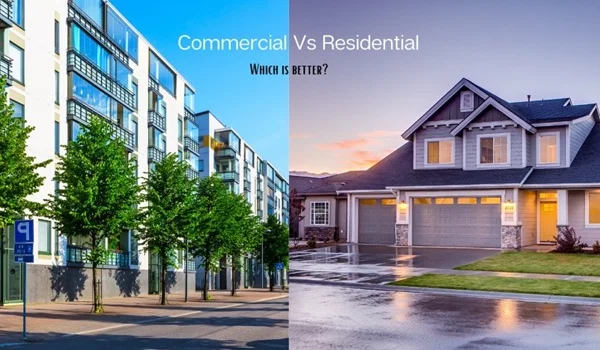
A residential property may include a flat, house or apartment intended for living, while commercial property can include shops, offices, showrooms, warehouses and other business-use spaces. The Real Estate (Regulation and Development) Act, 2016 recognises apartments and units used for residential or commercial purposes, including offices, shops, showrooms and godowns.
Before investing, it is useful to compare the purchase cost, rental income, vacancy, operating expenses, financing and potential returns rather than looking only at the expected rent.
Commercial Property vs Residential Property: Quick Comparison
| Factor | Commercial Property | Residential Property |
| Typical examples | Shops, offices, showrooms, warehouses | Flats, houses, apartments |
| Purchase cost | Often higher for prime locations | Wider range of options |
| Rental income | Often higher in absolute terms | Usually lower for a comparable investment |
| Lease period | Can be longer | Often shorter |
| Tenant type | Businesses and companies | Individuals or families |
| Vacancy impact | Can be significant due to longer reletting periods | Usually easier to find replacement tenants in high-demand areas |
| Maintenance | Can be higher depending on property | Generally easier to manage |
| Tenant modifications | May involve fit-outs and commercial requirements | Usually less extensive |
| Liquidity | Depends heavily on location and property type | Can have a broader buyer pool |
| Main demand drivers | Business activity, footfall, connectivity, employment hubs | Population, schools, transport, jobs and residential demand |
These are general characteristics. Actual returns can vary considerably by city, location, property type and market conditions.
What Is Residential Property Investment?
Residential property investment involves buying a property primarily intended for residential use and earning income by renting it out or selling it later.
Common examples include:
- 1 BHK and 2 BHK flats
- 3 BHK apartments
- Independent houses
- Builder floors
- Villas
- Residential plots, although plots do not normally generate rent unless developed or leased for an appropriate use
Residential properties are often considered by investors looking for a relatively straightforward rental model.
For example, an investor may purchase a ₹60 lakh apartment and rent it for ₹25,000 per month.
Annual rent:
₹25,000 × 12 = ₹3 lakh
Gross rental yield:
₹3 lakh ÷ ₹60 lakh × 100 = 5%
This is only an illustrative calculation. Actual rental yield depends on the property and location.
What Is Commercial Property Investment?
Commercial property investment involves purchasing a property intended for business or commercial activity.
Examples include:
- Retail shops
- Office spaces
- Showrooms
- Commercial floors
- Warehouses
- Certain business-use units
A commercial property can generate rental income from businesses operating from the premises.
For example:
- Property value = ₹1 crore
- Monthly rent = ₹70,000
- Annual rent = ₹8.4 lakh
Gross rental yield:
₹8.4 lakh ÷ ₹1 crore × 100 = 8.4%
Again, this is an illustrative example rather than a typical or guaranteed market return.
Commercial vs Residential Property: Purchase Costs
The initial investment is one of the biggest differences between the two categories.
Residential Property Costs
A residential buyer may have to budget for:
- Property price
- Stamp duty
- Registration charges
- Brokerage
- Legal verification
- Loan processing charges
- Interior work
- Furnishing
- Society or maintenance-related charges
Commercial Property Costs
A commercial buyer may additionally need to consider:
- Higher purchase price in prime business locations
- Stamp duty and registration
- Brokerage
- Legal due diligence
- Interior or fit-out expenses
- Building or facility charges
- Maintenance
- Property management
- Commercial financing costs, where applicable
The exact stamp duty, registration charges and other transaction costs depend on the state and transaction.
Which Property Usually Gives Higher Rent?
Commercial property can generate higher rental income relative to the purchase price in some locations, but this should not be treated as a universal rule.
For example, a shop located on a busy commercial road may command substantially more rent than a residential apartment of similar size.
However, commercial properties can also have:
- Higher purchase prices
- Longer vacancy periods
- Greater fit-out requirements
- Greater dependence on business activity
- More specialised tenant demand
Therefore, higher advertised rent does not automatically mean higher investment return.
How to Compare Rental Yield
The same basic formula can be used to compare rental properties:
Gross Rental Yield = (Annual Rent ÷ Property Value) × 100
Residential Example
Property value = ₹60 lakh
Monthly rent = ₹25,000
Annual rent = ₹3 lakh
Gross yield = 5%
Commercial Example
Property value = ₹1 crore
Monthly rent = ₹70,000
Annual rent = ₹8.4 lakh
Gross yield = 8.4%
The commercial property produces a higher illustrative yield in this example. However, the comparison should not stop there.
The investor should also calculate vacancy, maintenance, taxes, brokerage, financing and other expenses.
Net Rental Yield Matters More Than Gross Yield
Gross yield does not account for property expenses.
A better comparison is:
Net Rental Yield = (Annual Rent − Property Expenses) ÷ Total Investment × 100
Suppose a commercial property generates ₹8.4 lakh annual rent but has ₹1.2 lakh of annual expenses.
Net rental income:
₹8.4 lakh − ₹1.2 lakh = ₹7.2 lakh
If the total investment is ₹1.05 crore:
Net Rental Yield = ₹7.2 lakh ÷ ₹1.05 crore × 100 ≈ 6.86%
This gives a different picture from the 8.4% gross yield.
Vacancy Risk: Commercial vs Residential
Vacancy is an important part of real estate investment returns.
A residential flat in a location with strong rental demand may find a new tenant relatively quickly. But this is not guaranteed.
Commercial property can sometimes involve a different vacancy pattern. A business tenant may occupy a property for several years, but if the tenant leaves, finding another suitable business may take longer.
A property can therefore have a high rent during occupancy but still produce lower annual income if it remains vacant for a significant period.
What to Check
Before purchasing, estimate:
- Expected monthly rent
- Average vacancy period
- Tenant demand
- Number of competing properties
- Typical lease period
- Local rental growth
- Time required to find a new tenant
Lease Terms Can Be Different
Commercial leases may involve longer contractual periods and detailed clauses relating to:
- Security deposit
- Rent escalation
- Lock-in period
- Maintenance
- Fit-outs
- Repairs
- Property taxes
- Renewal
- Exit conditions
Residential rental arrangements can also contain these clauses, but the structure and negotiation may be different.
Investors should read the lease carefully rather than assuming that the advertised monthly rent represents the complete financial arrangement.
Financing Costs Should Be Compared
The financing structure can significantly affect your actual return.
Suppose two properties generate similar rental yields, but one requires substantially more borrowing or carries a higher financing cost.
Your monthly cash flow can then be very different.
Before purchasing with a loan, calculate:
Monthly Rent − Property Expenses − Loan Outgo = Approximate Monthly Cash Flow
This is separate from rental yield.
A property can have a positive rental yield but still require additional monthly funds if the loan repayment and other expenses are high.
Commercial Property and Residential Property: Maintenance
Maintenance requirements depend on the type of property.
For residential property, common expenses can include:
- Society maintenance
- Repairs
- Painting
- Plumbing
- Electrical work
- Appliance or furnishing replacement
For commercial property, expenses may include:
- Building maintenance
- Common-area charges
- Air-conditioning or facility costs
- Repairs
- Security
- Fit-out-related work
- Property management
The lease should clearly specify which expenses are paid by the owner and which are paid by the tenant.
Tax and TDS Considerations
Rental income and property transactions can have tax implications, and the applicable treatment depends on the property, taxpayer and transaction.
The Income Tax Department’s current guidance covers rental income and property-related taxation under the applicable income-tax provisions. For example, the tax return framework distinguishes income from house property and provides specific rules for let-out properties.
TDS can also apply to certain property purchases and rent payments. From 1 April 2026, the Income Tax Department states that the Income Tax Act, 2025 and corresponding rules apply to relevant TDS events, with Form 141 consolidating certain reporting requirements for specified property transfer and rent transactions.
Because tax treatment can change and depends on the transaction, investors should check the applicable provisions for the relevant financial year before completing a transaction.
Commercial Property vs Residential Property: Return Components
Real estate returns generally come from two broad sources:
- Rental Income
This is the regular income generated by leasing the property.
- Capital Appreciation
This is the potential increase in the property’s value over time.
For example, if you purchase a property for ₹70 lakh and later sell it for ₹85 lakh, the difference before applicable costs and taxes is ₹15 lakh.
However, appreciation is not guaranteed. Location, infrastructure, demand, supply, economic conditions and property-specific factors can all affect future prices.
Factors to Check Before Buying Commercial Property
Before investing in commercial real estate, check:
- Location and accessibility
- Footfall, where relevant
- Nearby businesses
- Tenant demand
- Existing tenant and lease
- Rent escalation clause
- Lock-in period
- Security deposit
- Vacancy history
- Maintenance charges
- Property title
- Approved use of the premises
- Building approvals
- Parking and access
- Developer/project details
- Exit options
Factors to Check Before Buying Residential Property
For residential investment, consider:
- Local rental demand
- Purchase price
- Expected rent
- Vacancy
- Maintenance charges
- Location and connectivity
- Nearby schools, offices and public transport
- Builder and project records
- Title and encumbrances
- RERA details where applicable
- Property taxes and other recurring expenses
- Resale demand
Which Has Lower Risk?
There is no single risk level that applies to every commercial or residential property.
Risk depends on factors such as:
- Location
- Purchase price
- Tenant quality
- Lease terms
- Vacancy
- Financing
- Property condition
- Legal documentation
- Local demand
- Exit liquidity
A prime commercial property with a strong tenant can have a very different risk profile from a vacant shop in a weak commercial location. Similarly, a residential apartment in a high-demand rental market can differ substantially from one with limited tenant demand.
Commercial vs Residential Property: Investment Checklist
Before investing, compare both options using the same numbers:
| Metric | Property A | Property B |
| Purchase price | ₹ | ₹ |
| Stamp duty & registration | ₹ | ₹ |
| Brokerage/legal costs | ₹ | ₹ |
| Initial renovation/fit-out | ₹ | ₹ |
| Total investment | ₹ | ₹ |
| Expected monthly rent | ₹ | ₹ |
| Expected annual rent | ₹ | ₹ |
| Expected vacancy | Months | Months |
| Annual expenses | ₹ | ₹ |
| Net rental income | ₹ | ₹ |
| Gross rental yield | % | % |
| Net rental yield | % | % |
| Loan cost, if applicable | ₹ | ₹ |
| Expected cash flow | ₹ | ₹ |
This makes the comparison more meaningful than simply comparing monthly rents.
Frequently Asked Questions
Is commercial property better than residential property for rental income?
Commercial and residential properties have different income, cost and risk characteristics. The actual rental return depends heavily on the property, location, tenant demand, purchase price and expenses.
Does commercial property always give higher rental yield?
No. Some commercial properties may offer higher yields, but this is not guaranteed. A high purchase price or long vacancy can reduce the actual return.
Is residential property easier to rent?
It depends on the location and property type. Residential properties in areas with strong tenant demand may have a broad pool of potential tenants, while specialised commercial properties may have a narrower tenant base.
What should I compare before buying a rental property?
Compare the total investment, expected rent, vacancy, maintenance, taxes, financing costs, lease terms, tenant demand and potential resale market.
Should I calculate gross or net rental yield?
Gross yield is useful for an initial comparison. Net rental yield is more useful for understanding the return after relevant property expenses.
Can commercial and residential properties both appreciate?
Yes, both can potentially appreciate, but future appreciation is not guaranteed. Market conditions and property-specific factors should be considered separately from rental income.
Conclusion
Commercial and residential properties can both be used as real estate investments, but they work differently. Commercial property may offer higher rental income in certain locations, while residential property can provide access to a wider range of budgets and tenant markets.
Instead of comparing only the rent, calculate the total acquisition cost, realistic annual rental income, vacancy, operating expenses, financing cost, taxes and net rental yield. This gives a clearer picture of the financial characteristics of each property before making an investment decision.