Getting a business loan can be difficult when you are starting a new business and do not yet have an Income Tax Return (ITR) showing business income. A new business may have no previous-year turnover, audited financial statements or established profit history.
However, not having an ITR does not automatically mean that you cannot obtain business finance. Depending on the loan product, lender and business profile, other information such as a business plan, bank statements, GST records, Udyam registration, projected cash flow, credit history and proof of business activity may be considered.
Government-backed programmes can also provide financing options for eligible new micro and small businesses.
Can You Get a Business Loan Without ITR?
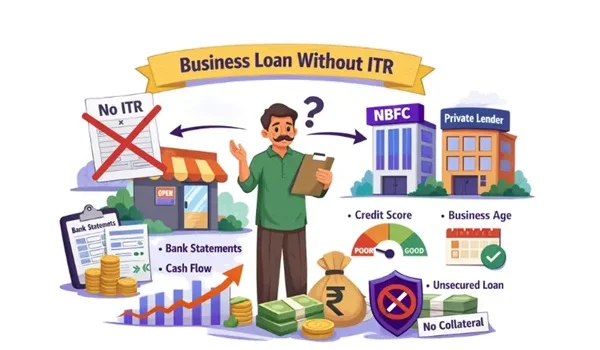
Yes, it can be possible, particularly for a new business that has not yet completed a financial year.
The important distinction is between:
- A new business that genuinely has no previous ITR, and
- An existing business that has been filing returns but is trying to avoid providing them.
For a genuinely new business, a lender may consider alternative evidence of the applicant’s repayment capacity and the viability of the proposed business.
However, there is no universal rule that lenders must approve a business loan without ITR. Each lender has its own credit and documentation requirements.
Digital MSME lending models can use information such as GST records, bank-account statements, credit information and other digital footprints when assessing applications.
Why Is ITR Usually Required for Business Loans?
ITR is commonly used by lenders to understand the financial position of an applicant or existing business.
It can help demonstrate:
- Reported income
- Business turnover
- Profitability
- Tax compliance
- Existing financial obligations
- Repayment capacity
A new business does not have historical business income, so the lender may need to rely on other information.
This is why getting a loan for a proposed business can require a different approach from getting a loan for an established business.
Ways to Get Business Finance Without Previous ITR
- Apply for a Government-Backed Business Loan Scheme
Government-backed schemes can be particularly relevant for new entrepreneurs.
One important option is the Pradhan Mantri MUDRA Yojana (PMMY).
The scheme provides collateral-free institutional credit to eligible micro enterprises. Current categories are:
| MUDRA Category | Loan Amount |
| Shishu | Up to ₹50,000 |
| Kishor | Above ₹50,000 to ₹5 lakh |
| Tarun | Above ₹5 lakh to ₹10 lakh |
| Tarun Plus | Above ₹10 lakh to ₹20 lakh |
Tarun Plus is intended for entrepreneurs who have previously availed and successfully repaid a Tarun-category loan under the specified scheme conditions.
PMMY can cover term-loan and working-capital requirements for eligible businesses in manufacturing, trading, services and certain allied activities.
Importantly, MUDRA does not mean automatic approval without documents. The lending institution still assesses the application.
- Consider PMEGP for a New Business
The Prime Minister’s Employment Generation Programme (PMEGP) is another option for eligible applicants establishing new micro-enterprises.
The scheme provides credit-linked margin-money subsidy for eligible new enterprises.
Current maximum admissible project costs are:
- ₹50 lakh for manufacturing
- ₹20 lakh for business/service activities
The beneficiary contribution and subsidy rate depend on the applicant category and location.
For new PMEGP units, Udyam registration is required before physical verification and adjustment of the margin money in the loan account.
PMEGP also has specific eligibility conditions. For example, applicants must generally be at least 18 years old, and for projects above specified cost levels, an VIII-standard educational qualification is required.
- Approach Banks With a Strong Business Plan
If you do not have previous business ITRs, your business plan becomes particularly important.
A good business plan should explain:
Business Details
- What product or service you will offer
- Target customers
- Location
- Business model
- Expected monthly sales
Investment Requirement
Clearly show how much money you need and where it will be used.
For example:
| Requirement | Amount |
| Equipment | ₹3 lakh |
| Initial inventory | ₹2 lakh |
| Shop/office setup | ₹1 lakh |
| Working capital | ₹2 lakh |
| Marketing | ₹50,000 |
| Other expenses | ₹50,000 |
| Total | ₹9 lakh |
The figures above are only an example. Your project report should contain realistic figures based on actual quotations and market research.
Expected Cash Flow
Explain:
- Expected monthly sales
- Gross margin
- Operating expenses
- EMI affordability
- Expected monthly surplus
This gives the lender a clearer picture of how the proposed loan could be repaid.
- Use Bank Statements as Supporting Evidence
If you do not have business ITRs, your bank statement can still provide useful financial information.
Depending on the lender’s requirements, bank statements may help demonstrate:
- Existing savings
- Regular income
- Business transactions
- Customer receipts
- Existing EMI payments
- Account conduct
For a completely new business, you may not have business transactions yet. In that case, the lender may look at other available financial information.
Some digital lending processes specifically use bank-account information and other digital data as part of credit assessment.
- Get Udyam Registration
Udyam Registration can establish that your business is registered within India’s MSME framework.
It can be useful when exploring MSME-focused credit facilities and government schemes.
However, Udyam Registration does not guarantee a loan.
A lender can still assess:
- Credit history
- Business viability
- Banking history
- Existing liabilities
- Promoter profile
- Loan amount
- Repayment capacity
The current MSME framework also supports credit access through various government programmes.
- Explore CGTMSE-Backed Credit
The Credit Guarantee Scheme through CGTMSE is another route worth discussing with participating lenders.
The scheme provides credit guarantee support to eligible lenders for credit facilities extended to eligible Micro and Small Enterprises.
The guarantee can enable eligible MSEs to obtain credit without collateral or third-party guarantees, subject to the scheme and lender’s conditions.
The important point is that CGTMSE does not directly give the entrepreneur the loan.
The borrower applies to a participating bank or financial institution. The lender evaluates the loan application and, where eligible, can obtain guarantee coverage under the scheme.
The current guarantee ceiling under the Credit Guarantee Scheme was enhanced to ₹10 crore from April 1, 2025.
Documents That May Help If You Don’t Have ITR
The exact requirements vary between lenders, but you may be asked for some combination of:
- Aadhaar
- PAN
- Address proof
- Bank statements
- Udyam Registration
- GST registration, if applicable
- Business registration documents
- Partnership deed or incorporation documents
- Business plan/project report
- Equipment quotations
- Rent agreement or premises documents
- Proof of business experience
- Credit history
- Income or financial documents of promoters
For PMMY applications through JanSamarth, current documentation guidance includes Aadhaar for individuals, PAN, Udyam-related verification, sales details and bank-account information.
Can a New Business Get a Loan Without GST?
GST registration and ITR are separate matters.
A business may not be required to register under GST in every situation. The requirement depends on factors such as turnover, nature of supply and applicable GST rules.
Therefore, not having GST registration does not automatically mean that you cannot apply for business finance.
However, if your business is required to be GST-registered, you should complete the applicable registration and compliance before representing the business to a lender.
Can You Get a ₹10 Lakh Business Loan Without ITR?
It can be possible, but the answer depends heavily on the lender and the type of loan.
For a new business, a lender may want stronger evidence of:
- Promoter contribution
- Business viability
- Credit history
- Business experience
- Projected cash flow
- Use of funds
- Repayment capacity
Government schemes may also have specific limits and eligibility requirements.
For example, under PMMY, the Tarun category covers loans above ₹5 lakh and up to ₹10 lakh.
That does not mean every new entrepreneur requesting ₹10 lakh will receive the amount.
How to Improve Your Chances of Getting a Loan
If you have no previous ITR, focus on strengthening the rest of your application.
Maintain a Good Credit History
Your personal credit history can become particularly relevant when the business has no established borrowing history.
Invest Some of Your Own Money
A reasonable promoter contribution can demonstrate that you also have financial involvement in the project.
Prepare a Detailed Project Report
Include realistic sales estimates, expenses, margins and cash-flow projections.
Keep Business Transactions Separate
Once the business starts, use a dedicated current account where appropriate and maintain clear financial records.
Avoid Too Many Loan Applications
Multiple credit applications within a short period can affect your credit profile depending on how lenders report and assess enquiries.
Keep All Business Documents Organised
Proper documentation can make the application process smoother.
ITR vs Alternative Documents
| Document | Why It Can Matter |
| ITR | Shows reported income and tax information |
| Bank statement | Shows financial transactions and account conduct |
| Udyam certificate | Establishes MSME registration |
| GST records | Can demonstrate taxable business activity where applicable |
| Business plan | Explains the proposed business |
| Project report | Shows investment and financial projections |
| Credit report | Shows borrowing and repayment history |
| Quotations | Support proposed equipment or asset costs |
| Business registration | Establishes legal business structure |
No single document replaces ITR in every lending situation. The lender decides which documents are acceptable for its particular loan product.
Things to Avoid
Be especially careful with businesses or agents promising:
- “Guaranteed business loan without ITR”
- “Loan without CIBIL verification”
- “100% approval”
- “Government loan without documents”
- “Instant ₹20 lakh loan for every new business”
Do not submit fake ITRs, fabricated bank statements or inflated business projections. False information can result in rejection and potentially create legal and financial problems.
Final Thoughts
Starting a business without previous ITRs does not necessarily prevent you from seeking business finance. The key is to identify a loan product that accepts new businesses and then provide strong alternative evidence of the project’s viability and your ability to repay.
For eligible entrepreneurs, options such as MUDRA, PMEGP and lender finance supported by CGTMSE can be worth exploring. MUDRA currently provides collateral-free credit categories up to ₹20 lakh, although the Tarun Plus category has a specific previous-loan repayment requirement.
Before applying, prepare your business plan, project cost, promoter contribution, bank records, Udyam registration and other applicable documents. Most importantly, check the lender’s current documentation requirements rather than assuming that every bank or NBFC offers business loans without ITR.