People often use the terms term insurance and life insurance interchangeably, but they are not exactly the same. Term insurance is actually a type of life insurance designed primarily to provide financial protection against the death of the insured during a specified policy term.
The broader category of life insurance includes several types of policies. Depending on the product, a life insurance policy may provide only death protection or may combine insurance with savings, investment-related features or maturity benefits.
Understanding this difference is important before choosing a policy.
Term Insurance vs Life Insurance at a Glance
| Feature | Term Insurance | Other Life Insurance Plans |
| Main purpose | Life-risk protection | Protection plus savings/other benefits, depending on plan |
| Policy term | Fixed period | Depends on the product |
| Premium | Generally lower for a given death cover | Usually higher for products offering additional benefits |
| Death benefit | Payable according to policy terms | Payable according to policy terms |
| Maturity benefit | Usually not payable in a standard pure-term plan | May be available in eligible plans |
| Savings component | Generally absent in pure-term insurance | May be present |
| Cash value | Generally not a feature of pure-term plans | May be available depending on product |
| Product types | Pure-risk term plans and variants | Endowment, whole life, participating/non-participating and other life products |
| Suitable for | People primarily seeking life-risk protection | People seeking products with additional contractual benefits |
The exact features depend on the individual policy and its terms and conditions.
What Is Term Insurance?
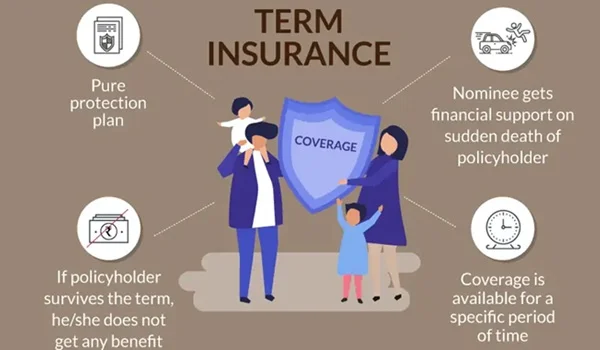
Term insurance is a pure-risk life insurance product that provides life cover for a specified period.
For example, suppose you purchase a term insurance policy with a ₹1 crore sum assured for 30 years. If the insured person dies during the policy term while the policy is in force, the death benefit is payable to the nominee according to the policy conditions.
A standard pure-term policy generally does not provide a maturity payout simply because the insured survives until the end of the term.
IRDAI’s life-insurance product framework recognises individual pure-risk products separately from savings products.
Main Features of Term Insurance
- Fixed policy term
- Life-risk protection
- Death benefit during the policy term
- Generally lower premium than many life insurance products with savings features
- No investment component in a standard pure-term plan
- Different premium-payment options may be available
- Optional riders may be offered depending on the insurer and product
What Is Life Insurance?
Life insurance is the broader category.
It includes term insurance as well as several other types of life insurance products.
Depending on the policy, life insurance can provide:
- Death benefit
- Maturity benefit
- Guaranteed benefits
- Bonuses in participating products
- Savings-related benefits
- Whole-life coverage
- Other benefits specified in the policy
IRDAI’s current framework distinguishes between participating and non-participating products and between linked and non-linked products. The benefits and conditions depend on the specific policy.
Therefore, saying that someone has “life insurance” does not tell you exactly what type of policy they have.
Types of Life Insurance
Life insurance products can have different structures.
- Term Insurance
Provides life cover for a specified period and is primarily designed for protection.
- Whole Life Insurance
Whole-life products generally do not have a conventional fixed maturity date in the same way as term insurance. The policy structure and benefits depend on the product.
- Endowment Plans
These combine life insurance with a savings component and may provide a maturity benefit if the policyholder survives the policy term, subject to the policy terms.
- Money-Back Plans
These products may provide scheduled payouts during the policy term along with insurance protection, depending on the policy.
- Participating Life Insurance
Participating policies may provide bonuses in addition to the guaranteed benefits specified in the policy, subject to the applicable terms. IRDAI’s product framework provides that bonuses and additional benefits under participating products form part of the death benefit when payable under the policy.
- Unit-Linked Insurance Plans
ULIPs combine life insurance with investment in market-linked funds. Their value can fluctuate based on the performance of the underlying investments and the policy structure.
Why Is Term Insurance Usually Cheaper?
The main reason is that a standard term plan is primarily designed to provide life-risk protection.
Consider two hypothetical policies with the same ₹1 crore death cover:
- Policy A: Pure term insurance
- Policy B: Life insurance policy with savings and maturity benefits
Policy B may have a higher premium because it can include benefits beyond pure death-risk coverage.
However, premiums are not determined only by the type of policy. Insurers consider factors such as:
- Age
- Policy term
- Sum assured
- Health
- Smoking/tobacco use
- Occupation
- Lifestyle and medical history
- Premium payment structure
Therefore, two people can receive very different premiums for similar coverage.
Does Term Insurance Have a Maturity Benefit?
A standard pure-term insurance policy generally does not pay a maturity benefit if the insured survives the policy term.
However, products with different structures or specific return-of-premium features may have different maturity provisions.
Always check the policy document rather than assuming that every term plan has the same maturity conditions.
Does Life Insurance Always Give Guaranteed Returns?
No.
“Life insurance” covers many different products. Some may provide guaranteed benefits, while others may include bonuses or market-linked investment components.
For participating policies, bonuses are subject to the applicable product terms and declarations. For market-linked products, returns depend on investment performance.
Therefore, investors should not assume that every life insurance policy provides a fixed or guaranteed investment return.
Term Insurance vs Traditional Life Insurance
A traditional life insurance policy may combine protection with savings or other benefits.
| Factor | Term Insurance | Traditional Savings-Oriented Life Insurance |
| Primary objective | Protection | Protection plus savings |
| Premium for same death cover | Generally lower | Can be higher |
| Maturity benefit | Usually no | May be available |
| Investment component | No in pure-term plans | May be part of the product |
| Bonuses | Generally not applicable to pure-term plans | May apply to participating plans |
| Complexity | Usually simpler | Can have more features and conditions |
The comparison should always be made between actual policy products rather than just their names.
Which One Do You Need?
The answer depends on what you want the insurance policy to accomplish.
If Your Main Goal Is Family Protection
If your primary concern is providing financial support to your dependants if you die during your earning years, a term insurance policy can be structured specifically for that purpose.
You can choose the cover amount and policy term based on your financial responsibilities, subject to the insurer’s underwriting.
If You Want Protection Plus Contractual Savings Benefits
If you want a policy that combines life insurance with savings or maturity benefits, you may consider other life insurance products.
You should examine:
- Guaranteed benefits
- Non-guaranteed benefits
- Premium payment period
- Policy term
- Maturity benefit
- Surrender conditions
- Death benefit
- Applicable charges
- Inflation impact
- Liquidity
If You Want Market-Linked Investment Exposure
Some life insurance products, such as ULIPs, have investment components linked to market performance.
These should be evaluated differently from pure term insurance because investment risk, charges, fund choices and policy conditions become relevant.
How Much Term Insurance Cover Should You Consider?
There is no single cover amount that is appropriate for everyone.
Instead of selecting a number only because it is commonly advertised, consider:
- Current annual income
- Outstanding home or personal loans
- Family’s regular expenses
- Children’s education needs
- Existing investments
- Existing life insurance
- Future financial responsibilities
- Number of dependants
- Years remaining until retirement
Simple Example
Suppose a person has:
- Annual family expenses: ₹6 lakh
- Outstanding loans: ₹40 lakh
- Future education and other financial responsibilities: ₹30 lakh
The required cover should be assessed by looking at these obligations along with existing assets and insurance.
The objective is to estimate the financial gap that the family could face after the insured person’s death.
What Should You Check Before Buying Term Insurance?
Do not compare policies only on premium.
Check:
Sum Assured
Confirm the death benefit and how it is payable.
Policy Term
The policy should cover the period during which financial protection is actually needed.
Premium Payment Term
Some policies offer regular, limited or other premium-payment structures.
Exclusions
Read the exclusions and conditions carefully.
Claim Process
Understand the documents and process required for a death claim.
Riders
Check whether optional benefits such as accidental death or critical illness riders are available and whether you actually need them.
Policy Conditions
Read the policy document, including grace period, lapse, revival, surrender and termination provisions.
IRDAI’s product framework also permits different premium-payment terms and policy-term structures, subject to applicable requirements.
Term Insurance vs Life Insurance: Common Misunderstandings
“Term Insurance Is Not Life Insurance”
Incorrect.
Term insurance is a type of life insurance.
“All Life Insurance Policies Give Maturity Returns”
Incorrect.
Maturity benefits depend on the specific product.
“Term Insurance Is Always Better Because It Is Cheaper”
Price alone does not determine whether a policy meets your needs. Different products serve different purposes.
“A Higher Premium Means Better Insurance”
Not necessarily. The important factors are coverage, contractual benefits, exclusions, policy term, conditions and suitability for your financial requirements.
“Life Insurance Is an Investment”
Some life insurance products have savings or investment components, but insurance and investment are not the same concept. A policy should first be understood based on its insurance benefits and contractual terms.
Frequently Asked Questions
Is term insurance and life insurance the same?
No. Term insurance is a type of life insurance. Life insurance is the broader category that includes term insurance and several other types of products.
Which is cheaper: term insurance or life insurance?
A pure-term policy will generally have a lower premium than a life insurance product that also provides savings or maturity benefits for the same broad level of life cover. Actual premiums vary according to the policy and applicant.
Does term insurance provide money if I survive the policy?
A standard pure-term policy generally does not provide a maturity benefit on survival. Specific products can have different terms, so the policy document should be checked.
Can I have both term insurance and another life insurance policy?
Yes. A person can have multiple life insurance policies, subject to the insurers’ underwriting and applicable rules.
Is life insurance useful if I already have term insurance?
It depends on your financial objectives and the existing policy. Another life insurance product may provide benefits that are different from those offered by a pure-term policy.
Should I choose term insurance or a savings-oriented life insurance plan?
Start by identifying whether your primary requirement is life-risk protection, savings-related contractual benefits, market-linked exposure or a combination of these. Then compare the actual policy features, costs and conditions.
Conclusion
The biggest difference to remember is simple: term insurance is a type of life insurance, not a separate category from life insurance.
A pure-term policy is primarily designed to provide financial protection for a specified period. Other life insurance products can combine protection with savings, maturity benefits, bonuses or investment-related features depending on their structure.
Before buying a policy, compare the death benefit, policy term, premium-payment period, maturity benefits, exclusions, surrender conditions and other contractual features. The right choice depends on the financial protection and benefits you actually need rather than on the product name alone.