When you need a large amount of money, two financing options you may come across are a Loan Against Property (LAP) and a personal loan.
Both can be used for different financial needs, but they work very differently. A personal loan is generally unsecured, meaning you do not mortgage property to obtain it. A Loan Against Property is secured against residential, commercial or other eligible property.
Because the lender gets security in a LAP, its interest rate may generally be lower than that of an unsecured personal loan. However, a LAP involves property as collateral, which creates a significant risk if the borrower fails to repay.
This guide compares Loan Against Property vs Personal Loan on interest rates, eligibility, loan amount, tenure, processing, risks and other important factors.
Loan Against Property vs Personal Loan: Key Difference
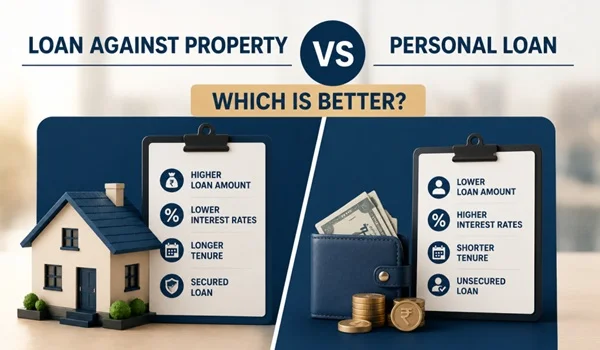
| Feature | Loan Against Property | Personal Loan |
| Security | Property is mortgaged to lender | Generally unsecured |
| Interest rate | Generally lower than unsecured borrowing | Generally higher |
| Loan amount | Can be relatively high, depending on property value and eligibility | Usually based mainly on income and credit profile |
| Tenure | Usually longer | Usually shorter |
| Property valuation | Required | Not required |
| Documentation | More extensive | Generally simpler |
| Processing | Can take longer | Usually faster |
| Risk of collateral loss | Yes, if the borrower defaults and the lender enforces security | No property collateral in a standard unsecured loan |
| Suitable for | Large funding requirements | Shorter-term or moderate funding needs |
Interest rates and loan terms are decided by individual lenders based on their pricing policies and the borrower’s profile. RBI requires lenders to maintain transparency around interest, fees and other loan terms.
What Is a Loan Against Property?
A Loan Against Property is a secured loan where you offer an eligible property as collateral to the lender.
Depending on the lender, the property could be:
- Residential property
- Commercial property
- Other eligible immovable property
You generally continue to own and use the property while repaying the loan, subject to the mortgage arrangement.
The lender evaluates factors such as:
- Property value
- Property title and documents
- Location
- Property type
- Borrower’s income
- Existing liabilities
- Credit history
- Repayment capacity
The amount sanctioned is generally linked to the lender’s assessment of the property’s value and the borrower’s repayment capacity.
What Is a Personal Loan?
A personal loan is generally an unsecured loan, so the borrower does not normally provide property as collateral.
The lender primarily evaluates:
- Income
- Employment or business profile
- Credit history
- Existing loans
- Monthly obligations
- Banking relationship
- Repayment capacity
Because there is no property security, the lender takes greater credit risk. This is one reason personal loans can carry higher interest rates than secured loans.
Interest Rate: LAP vs Personal Loan
Interest rate is one of the biggest differences between the two.
Loan Against Property
Since the loan is secured by property, the lender has collateral against the outstanding amount. This generally allows lenders to price LAP loans lower than unsecured personal loans, although the actual rate varies by lender and borrower.
Personal Loan
A personal loan does not normally have property security. Therefore, lenders generally price it according to the borrower’s credit risk.
Your actual rate may depend on:
- Credit score and credit history
- Income
- Employer or business profile
- Loan amount
- Tenure
- Existing relationship with the lender
- Internal credit assessment
Do not compare only the advertised interest rate. RBI’s Key Facts Statement framework requires regulated entities to provide key information about applicable loans, including the all-in cost through APR for covered retail and MSME loans.
Eligibility Comparison
Loan Against Property Eligibility
A lender may consider:
- Age
- Income
- Employment or business stability
- Credit history
- Property ownership
- Property title
- Property valuation
- Existing financial obligations
The property must satisfy the lender’s legal and technical requirements.
Personal Loan Eligibility
The lender generally focuses more heavily on your financial profile.
Common factors include:
- Age
- Monthly income
- Employment/business stability
- Credit history
- Existing EMIs
- Bank account activity
- Debt-to-income or repayment capacity
Because property verification is not normally required, the application process can be simpler.
Loan Amount: Which Can Provide More?
A LAP can generally support a larger borrowing requirement because the loan is secured by property.
For example, someone needing several lakh rupees for business expansion, education, medical expenses or another permitted purpose may consider LAP if they own suitable property.
A personal loan may be more appropriate when the funding requirement is smaller and the borrower has sufficient income and credit eligibility.
However, a larger sanctioned amount does not necessarily mean you should borrow more. Your EMI should remain manageable relative to your regular income.
Tenure Difference
LAPs can generally have longer repayment periods than personal loans.
A longer tenure reduces the monthly EMI but can increase the total interest paid over the life of the loan.
For example, consider an illustrative loan of ₹20 lakh:
| Factor | Shorter Tenure | Longer Tenure |
| Loan amount | ₹20 lakh | ₹20 lakh |
| Monthly EMI | Higher | Lower |
| Total interest | Generally lower | Generally higher |
| Repayment period | Shorter | Longer |
Therefore, borrowers should compare both EMI and total repayment, rather than choosing a loan only because its EMI appears lower.
Processing and Documentation
A personal loan is generally easier to process because there is no property valuation or mortgage documentation.
A LAP may involve:
- Income documents
- Identity and address proof
- Bank statements
- Property ownership documents
- Sale deed/title documents
- Property tax records where required
- Technical valuation
- Legal verification
- Existing loan or mortgage details, where applicable
The exact list varies by lender and property.
RBI’s fair-practice framework requires lenders to clearly communicate important terms and conditions and provide relevant loan documentation to borrowers.
Loan Against Property vs Personal Loan: Risks
The biggest difference is the type of risk involved.
Risk in a Personal Loan
Since the loan is generally unsecured, you do not normally pledge your house or other property.
However, failure to repay can still result in:
- Late or penal charges as applicable
- Collection action
- Negative credit-report information
- Legal recovery proceedings
- Difficulty obtaining future credit
Risk in a Loan Against Property
A LAP adds another major risk: the property offered as security is at stake if the borrower defaults and the lender enforces the security according to applicable law and the loan agreement.
This is particularly important if the mortgaged property is the family’s primary residence or an important business asset.
Therefore, a lower interest rate should not be considered in isolation. The borrower must understand the consequences of securing the loan against property.
Which Loan Is Faster?
A personal loan is generally faster because the lender does not need to conduct property valuation and title verification.
A LAP may take longer because the lender has to evaluate both:
- The borrower’s repayment capacity
- The property offered as security
The actual processing time depends on the lender, documentation and complexity of the property.
Which Loan Has More Documentation?
Generally:
Personal loan → Less property-related documentation
LAP → More documentation because of property verification and mortgage
If the property title has issues, missing documents, multiple owners or existing legal complications, the LAP process can become more difficult.
Can You Use Both Loans for Any Purpose?
The permitted end-use depends on the lender and product.
Personal loans are commonly marketed for general personal requirements, subject to the lender’s terms.
LAP products may also allow multiple uses, such as:
- Business requirements
- Education
- Medical expenses
- Debt consolidation
- Home-related expenses
- Other permitted personal or business purposes
However, some lenders may restrict certain uses. Always check the sanction letter and loan agreement.
Prepayment and Foreclosure Charges
Do not assume that the same prepayment rules apply to both products.
RBI’s framework says banks cannot charge foreclosure charges or prepayment penalties on floating-rate term loans sanctioned to individual borrowers. Similar provisions also apply to eligible floating-rate term loans from certain other regulated entities, subject to the applicable regulatory framework.
For fixed-rate loans and other situations, the applicable contract and regulatory rules need to be checked.
Before signing the loan agreement, check:
- Part-prepayment rules
- Foreclosure charges
- Lock-in period, if any
- Conversion charges
- Applicable taxes
- Other fees
RBI’s disclosure framework requires important charges and loan terms to be communicated transparently.
What Happens to the Property After a LAP Is Repaid?
After full repayment or settlement of an applicable loan, lenders covered by RBI’s responsible lending directions must release original movable or immovable property documents and remove charges registered with a registry within 30 days. If the delay is attributable to the lender, compensation is ₹5,000 per day.
This makes it important to collect the loan closure documents and verify that the mortgage or charge has been properly released.
Example: Comparing the Two Loans
Suppose you need ₹15 lakh.
Option 1: Personal Loan
You qualify for an unsecured personal loan based on your income and credit profile.
Advantages may include:
- No property mortgage
- Less documentation
- Faster processing
- No property valuation
But the interest rate may be higher.
Option 2: Loan Against Property
You own an eligible property and offer it as security.
Potential advantages include:
- Lower borrowing cost compared with many unsecured loans
- Potentially larger loan amount
- Longer repayment period
But you have additional costs and risks associated with property mortgage and verification.
The final comparison should therefore consider APR, total interest, processing charges, legal/technical charges, insurance if applicable, prepayment terms and the risk attached to the collateral.
Loan Against Property vs Personal Loan: Which Factors Should You Compare?
Before applying, create a comparison like this:
| Factor | What to Check |
| Interest rate | Fixed or floating and applicable rate |
| APR | Overall annualised cost |
| Loan amount | How much you actually need |
| EMI | Monthly repayment |
| Tenure | Total repayment period |
| Total interest | Overall borrowing cost |
| Processing fee | Upfront lender charge |
| Other charges | Legal, valuation, documentation etc. |
| Prepayment | Rules and charges |
| Security | Whether property must be mortgaged |
| Processing time | How quickly funds are required |
| Default consequences | Particularly important for LAP |
When a Personal Loan May Fit the Requirement
A personal loan may be considered when:
- You need funds relatively quickly
- You do not own suitable property
- You do not want to mortgage property
- The required amount is manageable through an unsecured loan
- You can comfortably handle the EMI
The higher rate should be evaluated against the convenience and absence of collateral.
When a Loan Against Property May Fit the Requirement
A LAP may be considered when:
- You own suitable property
- You need a relatively large amount
- A longer repayment period is useful
- The potential interest-rate difference is meaningful
- You are comfortable putting the property up as security
- Your income can support the EMI
The property risk should be clearly understood before signing the agreement.
Common Mistakes to Avoid
Choosing Only by Interest Rate
A lower rate does not necessarily mean a lower overall cost. Check APR and all applicable charges.
Borrowing More Because Property Is Available
A lender may offer a substantial amount against your property, but you should borrow based on your actual requirement and repayment capacity.
Ignoring Property Documentation
Title problems can delay or prevent a LAP.
Focusing Only on EMI
A longer tenure can reduce EMI but increase total interest.
Not Reading the Prepayment Clause
Check foreclosure and part-prepayment conditions before accepting the loan.
Putting Essential Property at Unnecessary Risk
If the loan amount can comfortably be managed without mortgaging an essential property, understand the additional risk before choosing a secured loan.
Frequently Asked Questions
Is a Loan Against Property cheaper than a personal loan?
A LAP generally has a lower interest rate than many unsecured personal loans because it is backed by property. However, the actual rate and total cost depend on the lender and borrower profile.
Is a personal loan safer than a Loan Against Property?
A standard personal loan does not normally put a specific property up as collateral. A LAP does. However, both loans carry financial and credit consequences if repayments are missed.
Can I get a higher loan amount through LAP?
Potentially, yes. The lender can consider the property’s value along with your income, credit profile and repayment capacity.
Does LAP require property valuation?
Generally, yes. The lender normally needs to assess the property’s value and legal status before accepting it as security.
Which has a longer tenure?
LAPs generally offer longer repayment periods than personal loans, although the actual maximum tenure varies by lender and product.
Can I use a Loan Against Property for business?
Many lenders offer LAP products that can be used for eligible business purposes. Check the specific lender’s end-use conditions before applying.
What happens if I cannot repay a LAP?
Because the property is security for the loan, continued default can eventually lead to enforcement of the security under applicable law and the loan agreement. This is one of the most important risks to consider before taking a LAP.
Conclusion
The main difference between a Loan Against Property and a Personal Loan is collateral.
A personal loan generally offers simpler processing without mortgaging property, but its interest rate can be higher. A LAP can provide access to larger funding at a potentially lower rate and longer tenure, but it involves property valuation, additional documentation and the risk associated with the mortgaged property.
Before choosing either option, compare the interest rate, APR, total interest, fees, tenure, EMI, prepayment conditions and default consequences. Most importantly, borrow only an amount that you can comfortably repay from your regular cash flow.