Investors may need to transfer shares from one demat account to another for several reasons. You may have opened a new demat account with another broker, want to consolidate your investments, transfer shares between your own accounts, or gift securities to another person.
The process is generally straightforward, but the exact procedure depends on whether the two accounts are with the same depository or different depositories, and whether you use an online facility or a physical Delivery Instruction Slip (DIS).
In India, the two depositories are CDSL and NSDL. CDSL provides online transfer facilities through Easiest, while depository participants may also provide electronic instruction facilities such as eDIS.
Can You Transfer Shares From One Demat Account to Another?
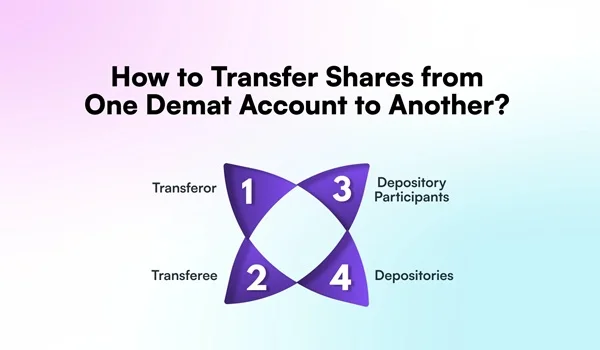
Yes. Shares and other eligible securities can generally be transferred from one demat account to another.
The transfer can be:
- Between two CDSL accounts
- Between two NSDL accounts
- From CDSL to NSDL
- From NSDL to CDSL
- Between your own demat accounts
- To another person’s demat account, subject to applicable requirements
A transfer between two beneficial-owner accounts within CDSL is referred to as an off-market transaction. A transfer involving different depositories is an inter-depository transfer.
Quick Overview of the Transfer Process
| Step | What You Need to Do |
| 1 | Check the depository of both demat accounts |
| 2 | Collect the destination account’s DP ID and Client ID/BO ID |
| 3 | Check the ISIN and quantity of shares |
| 4 | Choose online or physical transfer method |
| 5 | Add/verify the beneficiary if required |
| 6 | Submit the transfer instruction |
| 7 | Complete OTP/electronic authentication if applicable |
| 8 | Pay applicable transfer charges, if any |
| 9 | Check the destination demat account after processing |
Step 1: Check Whether the Accounts Are With CDSL or NSDL
Before starting the transfer, identify the depository of both accounts.
You can usually find this information in your demat account statement or account details.
The transfer method can differ depending on whether you are transferring:
CDSL → CDSL
NSDL → NSDL
CDSL → NSDL
NSDL → CDSL
If both accounts are under CDSL, CDSL’s Easiest facility can be used for online debit instructions. CDSL states that Easiest supports off-market and inter-depository transactions.
Step 2: Keep the Destination Account Details Ready
You will generally need details of the demat account receiving the shares.
These may include:
- Depository name
- DP ID
- Client ID
- BO ID
- Beneficiary account details
- ISIN of the security
- Number of shares to be transferred
A CDSL BO ID is a 16-digit demat account number.
Important: Enter the destination account details carefully. An incorrect DP ID, Client ID or ISIN can result in a failed or wrongly instructed transfer.
Step 3: Check the ISIN of the Shares
Every security has an ISIN (International Securities Identification Number).
For example, if you want to transfer shares of a particular company, do not rely only on the company name. Check the ISIN shown in your demat statement or broker’s holdings section.
You should also verify:
- Security name
- ISIN
- Quantity
- Available balance
- Whether the shares are free or already pledged/blocked
Only securities that are available for transfer can normally be debited.
Step 4: Choose Online Transfer or DIS
There are two common ways to initiate a transfer.
Online Transfer
Depending on your depository and DP, you may be able to use an online facility.
For CDSL accounts, Easiest allows investors to submit debit instructions electronically. CDSL states that transactions submitted through Easiest do not require a physical DIS.
Your broker or DP may also provide an electronic transfer facility through its own platform.
Physical DIS
You can also submit a Delivery Instruction Slip (DIS) to your DP where this method is supported.
CDSL explains that a DIS can be used for off-market, inter-depository and on-market transactions.
How to Transfer Shares Online Through CDSL Easiest
If your source account is with a CDSL DP and the DP supports Easiest, you can use CDSL’s online facility.
Step 1: Register for Easiest
Register through the CDSL Easiest platform and provide the required demat details and OTP authentication.
Depending on the option selected, DP authentication may be required before the facility becomes active.
Step 2: Add the Destination Account
For an off-market transfer, you may need to add the receiving demat account as a beneficiary.
CDSL’s current operating instructions provide for registration of the transferee account before execution of an off-market transfer. The beneficiary can be added electronically, with OTP authentication.
Step 3: Enter the Transfer Details
After logging in, enter the required transaction details, such as:
- Receiving account
- ISIN
- Quantity
- Transfer type
- Execution date, where applicable
CDSL’s Easiest FAQ states that securities can be transferred through the Set Up or Upload option available under the transaction menu.
Step 4: Authenticate the Instruction
Complete the authentication required by the applicable Easiest setup.
The exact authentication method depends on the type of Easiest account and facility being used.
Step 5: Check the Transfer Status
After submitting the instruction, monitor its status through the relevant platform and verify the securities in the receiving demat account after processing.
How to Transfer Shares Using a Delivery Instruction Slip
If you prefer the physical method, you can request a DIS from your DP.
The general process is:
- Obtain the DIS booklet from your DP.
- Enter the receiving demat account details.
- Enter the ISIN of each security.
- Enter the number of shares.
- Select the applicable transfer type.
- Sign the instruction as required.
- Submit the DIS to your DP.
- Obtain an acknowledgement.
- Check the source account for the debit and the destination account for the credit.
CDSL advises investors to use the prescribed instruction process for transferring securities and to retain appropriate records of submitted instructions.
CDSL to CDSL Share Transfer
When both accounts are with CDSL, the transfer is generally treated as an off-market transfer when it is not connected with a stock-exchange trade.
For example:
Your old CDSL account → Your new CDSL account
You can use the applicable online facility such as Easiest, if supported, or submit a DIS to the DP.
CDSL’s Easiest facility supports transfers to other CDSL demat accounts, including through its trusted-account or account-of-choice options.
CDSL to NSDL Share Transfer
When the source account is with CDSL and the receiving account is with NSDL, it is an inter-depository transfer.
You need to provide the correct details of the NSDL receiving account and follow the transfer procedure prescribed by the source DP.
CDSL specifically recognises inter-depository transfers as transfers involving securities going to or coming from an account outside CDSL.
NSDL to CDSL Share Transfer
The reverse process is also possible.
If your old account is with NSDL and your new account is with CDSL, you need to provide the destination CDSL account details to the NSDL DP and complete the required transfer instruction.
The exact online process depends on the NSDL participant and the facility it offers.
Is There a Charge for Transferring Shares?
There can be a charge, depending on the DP and type of transfer.
Possible charges include:
- Off-market transfer charges
- Inter-depository transfer charges
- DP transaction charges
- Applicable taxes, where relevant
- Other service charges
There is no single universal transfer fee applicable to every demat account. Check the latest schedule of charges of your DP before initiating the transfer.
Does Transferring Shares Affect Your Ownership?
If you transfer shares between two demat accounts belonging to you, the transfer changes the account in which the securities are held, but it does not mean you have sold the shares merely because they moved between your accounts.
However, transfers to another person can have different legal and tax implications depending on the reason and circumstances of the transfer.
Therefore, if you are transferring securities as a gift or for a family arrangement, check the applicable tax and documentation requirements separately.
Does Share Transfer Trigger Capital Gains Tax?
A transfer between your own demat accounts is generally different from selling the shares on the stock exchange.
However, tax treatment can depend on the nature and purpose of the transfer.
For example, transferring securities to another person as a gift can involve separate income-tax rules, and a later sale by the recipient can have implications for cost and holding-period calculations.
Therefore, do not assume that every demat transfer has the same tax treatment.
Common Mistakes to Avoid
Entering the Wrong DP ID
Always verify the receiving account details from the destination broker or DP.
Using the Wrong ISIN
The company name alone is not enough. Verify the ISIN.
Transferring More Shares Than Available
Check the free quantity before submitting the instruction.
Forgetting to Add the Beneficiary
Some electronic transfer facilities require the destination account to be registered before the transfer.
Ignoring Transfer Charges
Check the latest DP tariff before submitting the instruction.
Closing the Old Demat Account Too Early
If you are moving investments to a new broker, first confirm that all required securities have reached the new account before closing the old one.
How Long Does a Demat Share Transfer Take?
The processing time can vary depending on:
- Depository
- DP
- Transfer method
- Type of transfer
- Whether the instruction is complete
- Whether additional authentication is required
Online and physical instructions may have different processing timelines.
If the transfer does not appear within the expected timeframe provided by your DP, check the transaction status and contact the DP.
Frequently Asked Questions
Can I transfer shares from one demat account to another?
Yes. Securities can generally be transferred between demat accounts through the applicable online or physical instruction process.
Can I transfer shares between two brokers?
Yes. If both brokers provide demat services, you can transfer eligible securities from the old demat account to the new one.
Can I transfer shares from CDSL to NSDL?
Yes. Such a transaction is treated as an inter-depository transfer and requires the appropriate instructions and account details.
Can I transfer shares between my own demat accounts?
Yes. Investors commonly do this when consolidating holdings or moving investments to another broker.
Do I need to sell shares before transferring them?
No. A demat transfer is different from selling shares. Eligible securities can be transferred without placing a sell order.
Is a physical DIS mandatory?
No. Where supported, electronic facilities such as CDSL Easiest can be used instead of a physical DIS.
Can I transfer only some shares?
Yes. You can generally specify the quantity of a particular security to be transferred, subject to the applicable process and available balance.
Conclusion
Transferring shares from one demat account to another does not necessarily require selling and buying the securities again. Investors can use online depository facilities or a physical DIS, depending on their DP and the type of transfer.
Before submitting the instruction, carefully verify the DP ID, Client ID/BO ID, ISIN and quantity. Also check whether the transfer is CDSL-to-CDSL, NSDL-to-NSDL or inter-depository because the procedure can differ.
For CDSL accounts, the Easiest facility provides an electronic way to submit eligible transfer instructions without submitting a physical DIS.