When you have a home loan, there are two common ways to reduce the interest burden:
- Make a part-prepayment using a lump sum amount.
- Increase your EMI so that you repay the principal faster.
Both methods can reduce the total interest paid because the loan gets repaid earlier. However, they work differently.
A part-prepayment immediately reduces the outstanding principal, while an EMI increase puts more money towards principal every month.
The right approach depends on your available surplus, monthly cash flow, loan terms and financial priorities.
What Is Home Loan Prepayment?
Home loan prepayment means paying an amount towards your outstanding loan before the scheduled repayment date.
For example, suppose your outstanding home loan is ₹35 lakh and you make a part-prepayment of ₹5 lakh.
Your principal could reduce to approximately ₹30 lakh, subject to how the lender adjusts the payment and any applicable charges or conditions.
Because future interest is calculated on the outstanding loan balance, reducing the principal can reduce future interest.
What Does Increasing the EMI Mean?
Increasing the EMI means voluntarily paying more than your current scheduled monthly instalment.
Suppose your current EMI is ₹40,000.
You increase it to ₹50,000.
The additional ₹10,000 goes towards faster repayment of the loan, subject to the lender’s amortisation process.
As the principal is reduced faster, the remaining loan tenure can fall and the total interest paid can decrease.
Prepayment vs EMI Increase: Key Difference
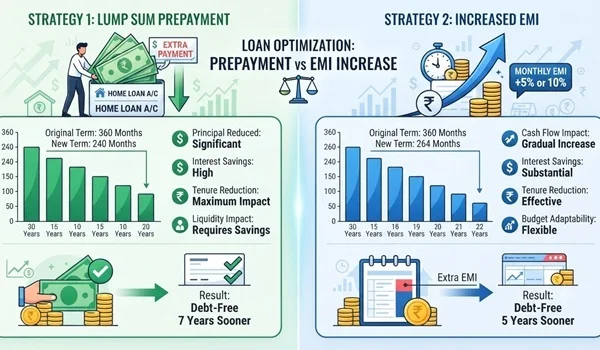
| Factor | Part-Prepayment | EMI Increase |
| Payment pattern | One-time or occasional lump sum | Higher payment every month |
| Immediate principal reduction | High | Gradual |
| Effect on interest | Can be significant | Builds over time |
| Impact on monthly cash flow | Usually temporary | Permanent increase in EMI |
| Requires surplus cash | Yes | Requires higher regular income |
| Suitable for | Bonuses, savings or large surplus | Stable income and regular cash flow |
| Loan tenure | Can reduce substantially | Usually reduces gradually |
Example: ₹40 Lakh Home Loan
Consider an illustrative home loan with:
- Outstanding principal: ₹40 lakh
- Interest rate: 8% per year
- Remaining tenure: 15 years
- Approximate current EMI: ₹38,227
If you continue with this EMI for the full remaining tenure, the approximate future interest would be ₹28.81 lakh.
Now consider two different strategies.
Option 1: Make a ₹5 Lakh Part-Prepayment
Suppose you have ₹5 lakh available and use it to reduce the principal.
The outstanding principal becomes approximately ₹35 lakh.
If the EMI remains around ₹38,227 and the interest rate remains unchanged, the loan can be repaid considerably earlier and the future interest can fall.
The exact saving depends on whether the lender reduces the tenure or EMI after the prepayment.
Option 2: Increase EMI
Instead of using ₹5 lakh immediately, suppose you increase your EMI from approximately ₹38,227 to ₹43,227.
The additional ₹5,000 is paid every month.
This also reduces the principal faster and shortens the repayment period.
However, it takes time for the additional monthly payments to build up to ₹5 lakh.
This is the key difference:
A lump-sum prepayment reduces principal immediately, while an EMI increase reduces principal gradually.
Which Reduces Interest Faster?
If you have the same amount of money available today, a part-prepayment generally reduces interest sooner because the principal falls immediately.
For example:
₹5 lakh prepayment today → immediate reduction in principal → lower interest calculation from the reduced balance.
By comparison:
₹5,000 additional EMI every month → gradual reduction in principal → interest savings accumulate over time.
Therefore, the timing of the payment matters.
However, this does not mean that every borrower should use all available savings for prepayment.
Keeping an adequate emergency fund and maintaining sufficient liquidity is also important.
What If You Increase EMI by 10% Every Year?
Another strategy is to increase the EMI whenever your income increases.
For example:
- Current EMI: ₹40,000
- After one year: ₹44,000
- Following year: ₹48,400
- Continue increasing as income permits
This is sometimes easier than making a large lump-sum payment.
The actual benefit depends on the amount and timing of each EMI increase.
A borrower with a stable salary may find this approach easier to maintain because the repayment rises gradually with income.
What If You Receive a Bonus?
A bonus or other large financial inflow can be used for part-prepayment, provided doing so fits your overall financial plan.
Before making the payment, consider whether you already have:
- Emergency savings
- Adequate health insurance
- Adequate life insurance where required
- High-interest debt
- Near-term financial obligations
Using every available rupee for home-loan prepayment can leave you with insufficient cash for emergencies.
Should You Reduce EMI or Tenure After Prepayment?
This is an important decision.
Suppose your outstanding loan falls after a ₹5 lakh prepayment.
The lender may offer options such as:
Keep EMI Similar and Reduce Tenure
The monthly payment remains approximately the same, but the loan finishes earlier.
This generally produces greater interest savings because the principal is repaid faster.
Reduce EMI and Keep Tenure Similar
The monthly burden falls, but the loan remains outstanding for longer.
This can improve monthly cash flow, but the interest saving may be lower than if you maintain the higher EMI.
The exact effect depends on the loan balance, interest rate and remaining tenure.
Example of the Difference
Suppose your outstanding loan is ₹30 lakh and you make a ₹5 lakh prepayment.
You now have ₹25 lakh outstanding.
You could:
Option A: Continue paying the existing EMI and finish the loan earlier.
Option B: Ask the lender to recalculate the EMI downward while maintaining a similar tenure.
If your primary objective is reducing total interest, keeping the EMI unchanged can result in faster principal repayment.
If your priority is reducing monthly financial pressure, a lower EMI may be more suitable.
What About Increasing EMI Instead of Prepaying?
Increasing EMI has one major advantage: you do not need a large lump sum.
For example, a borrower who cannot spare ₹5 lakh today may still be able to increase the EMI by ₹5,000 or ₹10,000 every month.
This creates a disciplined repayment strategy.
It can be particularly useful when:
- Income is stable
- Salary is expected to increase
- There is no large lump sum available
- The borrower wants to maintain liquidity
- The borrower prefers predictable monthly payments
When Can Part-Prepayment Be Useful?
A lump-sum prepayment can be considered when you have:
- A large bonus
- Sale proceeds from an asset
- Excess savings
- An inheritance
- A large maturity amount
- Other surplus funds
But do not use money required for essential expenses or emergencies simply to reduce the home loan.
When Can Increasing EMI Be Useful?
An EMI increase may be practical when:
- Your salary has increased
- Your monthly expenses have reduced
- You have a stable income
- You want to repay the loan gradually
- You do not have a large lump sum
For example, after receiving a salary increment, you could allocate part of the increase towards your home loan instead of allowing your entire monthly expenditure to rise.
Can You Combine Both Strategies?
Yes.
You do not necessarily have to choose only one.
For example:
- Make a ₹3 lakh prepayment from a yearly bonus
- Increase EMI by ₹5,000 per month
- Make another prepayment when a large surplus becomes available
This can accelerate repayment while avoiding the need to use all your savings at once.
What Does RBI Say About Prepayment Charges?
For eligible floating-rate loans to individual borrowers, RBI rules restrict lenders from charging foreclosure/prepayment penalties in applicable cases.
RBI’s existing framework states that banks cannot charge foreclosure charges or prepayment penalties on floating-rate home loans, and the restriction also covers floating-rate term loans sanctioned to individual borrowers.
However, borrowers should check the exact nature of their loan and the lender’s current terms before making a payment.
Other charges or administrative conditions may apply in particular situations.
What Happens to EMI When Interest Rates Change?
If your home loan has a floating interest rate, the interest rate can change according to the applicable benchmark and lender’s spread.
When the rate increases, the lender may adjust the EMI, tenure or both.
RBI’s framework for EMI-based floating-rate personal loans requires lenders to provide borrowers with options at the time of interest-rate reset, including increasing EMI, extending tenure, or using a combination of the two. Eligible borrowers must also be offered an option to switch to a fixed rate, subject to the lender’s policy and applicable charges.
Therefore, borrowers should periodically review their loan even if they are already making regular EMI payments.
Prepayment vs EMI Increase: Simple Comparison
| Situation | Possible Approach |
| You have a large surplus today | Part-prepayment |
| You have stable monthly income | EMI increase |
| You receive an annual bonus | Part-prepayment |
| You want to maintain liquidity | EMI increase |
| You want immediate principal reduction | Part-prepayment |
| You cannot arrange a large lump sum | EMI increase |
| You receive both salary increments and bonuses | Combine both |
How to Decide Between the Two
Consider these five questions:
- How much surplus cash do you have?
If you have a substantial surplus after maintaining an emergency fund, prepayment becomes an option.
- How stable is your income?
If your income is stable, increasing EMI may be easier to maintain.
- How long is the remaining tenure?
The longer the remaining tenure, the more time there is for interest savings from faster principal repayment to accumulate.
- What is your current interest rate?
A higher loan rate generally means that reducing the outstanding principal can have a larger impact on future interest.
- Do you have more expensive debt?
If you have outstanding high-interest debt, compare its cost before directing all surplus money towards a relatively lower-cost home loan.
Common Mistakes to Avoid
Using All Savings for Prepayment
Do not leave yourself without an emergency reserve.
Choosing a Lower EMI Automatically
A lower EMI can increase the time required to repay the loan.
Ignoring the Interest Rate
The benefit of prepayment depends partly on the applicable interest rate.
Not Checking Lender Rules
Review the lender’s current loan terms before making a large payment.
Focusing Only on EMI
Always compare:
Total interest + remaining tenure + monthly cash flow
rather than looking at EMI alone.
Frequently Asked Questions
Is home loan prepayment better than increasing EMI?
Both can reduce interest by accelerating principal repayment. A lump-sum prepayment reduces the principal immediately, while an EMI increase spreads the additional repayment over time.
Which saves more interest: prepayment or EMI increase?
If the same amount of money is available immediately, a prepayment generally reduces the outstanding principal sooner. The actual saving depends on the loan balance, interest rate, remaining tenure and repayment structure.
Should I reduce EMI or tenure after prepayment?
If your objective is to repay the loan faster and reduce future interest, keeping the EMI similar and allowing the tenure to fall can accelerate repayment. Reducing EMI can instead improve monthly cash flow.
Can I increase my home loan EMI every year?
The possibility and process depend on the lender and loan agreement. You can ask the lender whether the EMI can be increased and whether the change affects the tenure.
Are there prepayment charges on floating-rate home loans?
RBI rules prohibit banks from charging foreclosure/prepayment penalties on eligible floating-rate home loans to individual borrowers. Specific loan structures and lenders should still be checked before making a payment.
Does prepayment reduce the principal or interest?
A part-prepayment is used to reduce the outstanding principal. Because future interest is calculated on the outstanding balance, reducing the principal can reduce future interest.
Conclusion
Home loan prepayment and EMI increase can both reduce your interest burden by helping you repay the principal faster.
A lump-sum prepayment has an immediate effect because the outstanding principal falls at once. Increasing the EMI works gradually but can be easier for borrowers with stable monthly income who do not have a large surplus available.
You can also combine both strategies by making occasional prepayments while increasing the EMI after salary increments.
Before making a decision, check your outstanding principal, interest rate, remaining tenure, EMI, available savings and other financial obligations. Most importantly, do not judge the strategy only by the EMI. Compare the remaining tenure and total interest payable to understand the actual impact on your home loan.